Cyber Insurance Readiness
Cyber Insurance Ready
Starts with Cybersecurity Ready.
Cyber insurance applications are asking businesses increasingly detailed questions about the security controls protecting their systems. PC Vax helps establish, manage, and document important endpoint-security controls before underwriting becomes a last-minute problem.
Your Insurance Application Is Asking Security Questions.
Do You Know the Answers?
You may be asked:
- Do you use Endpoint Detection & Response?
- Is your endpoint security monitored?
- Is monitoring available 24/7?
- Do you have a patch-management process?
- Is multifactor authentication enabled?
- Are backups maintained?
- Do employees receive security awareness training?
- Do you have an incident-response process?
For many small businesses, these questions expose something important:
Nobody has ever clearly defined their cybersecurity controls.
PC Vax helps change that.
Start with the Endpoints.
PC Vax provides a professionally managed endpoint-security foundation built around:
Managed EDR
Endpoint Detection & Response designed to identify suspicious activity beyond traditional antivirus.
24/7 Security Monitoring
Continuous monitoring backed by professional security operations.
Human Threat Investigation
Suspicious behavior can be reviewed to determine whether it represents an actual threat.
Managed Response
Supported malicious activity can be contained or remediated.
Endpoint Inventory
Maintain clearer visibility into which business computers are protected.
Security Reporting
Document endpoint coverage, activity, and recommendations.
Powered by Huntress. Managed by PC Vax.
Patch Management
A Cyber Insurance Application May Ask How You Manage Updates.
PC Vax Managed Patch Management provides an organized process for maintaining supported endpoint software. This can help deploy important updates, identify failed patches, improve visibility, reduce exposure to known vulnerabilities, and document that patching is actively managed.
Endpoint Security + Patch Management is a significantly stronger foundation than unmanaged antivirus alone.
Documentation
What PC Vax Helps You Establish
- Endpoint Protection
- Managed EDR
- 24/7 Endpoint Security Monitoring
- Professional Threat Investigation
- Managed Response
- Managed Patch Management
- Endpoint Inventory
- Endpoint Security Reporting
The exact applicability of any control depends on the insurer’s specific wording and requirements.
Documentation You Can Actually Hand Over.
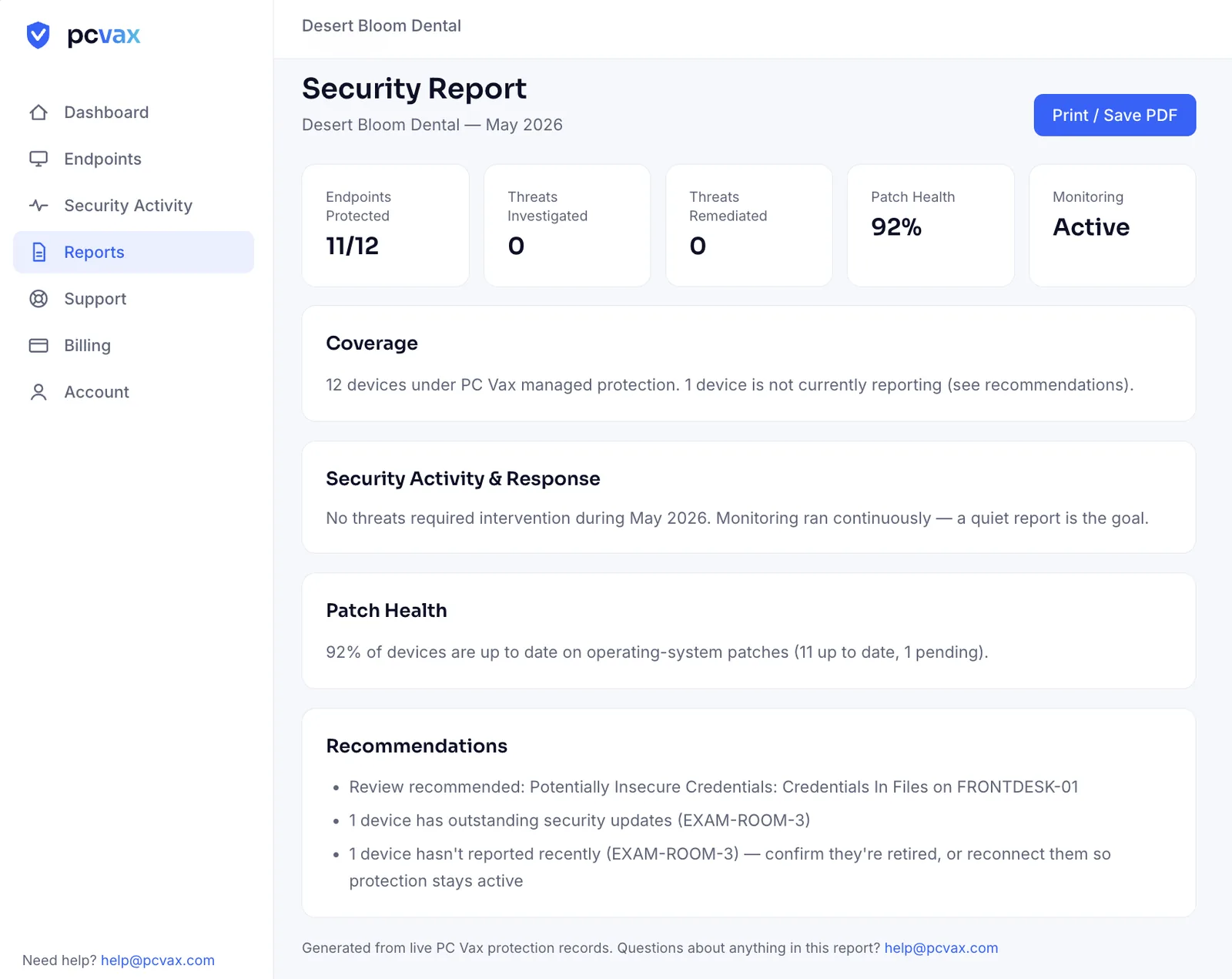
Monthly security reports document your coverage, security activity, and patch health — the kind of record that turns questionnaire answers from “we think so” into “here’s the report.”
Cyber Insurance Is Bigger Than Endpoint Security.
PC Vax is an important starting point. But underwriting may also evaluate:
Multifactor Authentication
Especially for email, Microsoft 365, remote access, and administrative accounts.
Backups
Including business data, servers, cloud services, and backup separation.
Email Security
Phishing and account compromise remain major business risks.
Security Awareness Training
Employees are part of the security environment.
Network Security
Firewalls and secure remote access may be evaluated.
Incident Response
Businesses may need documented processes for responding to security incidents.
PC Vax can help identify these gaps even when the control itself is delivered through another service.
Readiness Review
Example Security Readiness Snapshot
A PC Vax readiness review evaluates controls using simple status categories: Implemented, Partially Implemented, Not Implemented, Unknown, and Requires Review.
The purpose is not to declare the organization “compliant.” The purpose is to show where the security foundation is strong and where additional work may be necessary.
- Managed EDRImplemented
- 24/7 Security MonitoringImplemented
- Managed Patch ManagementImplemented
- MFARequires Review
- BackupsUnknown
- Email SecurityRequires Review
- Security Awareness TrainingNot Implemented
- Firewall / Network SecurityRequires Review
- Incident Response PlanNot Implemented
Don’t Wait Until Renewal Week.
Cyber insurance preparation is much easier when cybersecurity controls are addressed before the application deadline.
Waiting until an underwriter identifies a missing requirement can create:
- Delays
- Emergency technology purchases
- Confusion
- Last-minute remediation
- Application uncertainty
PC Vax gives businesses a practical way to strengthen endpoint security before the pressure begins.
Applying Right Now?
If your application asks whether your business uses EDR, managed endpoint security, 24/7 security monitoring, or patch management — PC Vax can help. For other controls, we can help identify what may need additional review.
Working with an Insurance Broker?
Great. PC Vax does not replace your insurance professional. Your broker continues advising you on coverage, policy limits, carrier selection, insurance terms, and the underwriting process. PC Vax focuses on cybersecurity, working alongside your broker on technical security-control questions.
Working with an Existing IT Provider?
Also great. PC Vax can work alongside your existing IT consultant, MSP, or internal IT team. They continue managing your technology environment while PC Vax focuses on professionally managed endpoint cybersecurity.
For Insurance Brokers
Have a client stuck because they don’t have EDR or can’t answer technical security questions? Refer them to PC Vax. We’ll handle the cybersecurity conversation. You keep the insurance relationship.
What PC Vax Does Not Promise
PC Vax does not guarantee:
- Insurance eligibility
- Policy approval
- Coverage
- Specific premiums
- Premium reductions
- Carrier acceptance
- Compliance with every underwriting requirement
No cybersecurity vendor can responsibly make those promises across every insurer and policy. What PC Vax can do is help businesses establish a stronger and more clearly documented cybersecurity foundation.
Cyber Insurance Is One Reason to Improve Security.
Protecting the Business Is the Bigger One.
The goal should not simply be checking a box on an insurance application. Security controls such as EDR, monitoring, patching, MFA, and backups can reduce real operational risk.
Step 1
Review
Understand what controls currently exist.
Step 2
Identify Gaps
Determine what may require improvement.
Step 3
Implement
Deploy PC Vax and other appropriate controls.
Step 4
Document
Maintain visibility into the security controls in place.
Step 5
Apply or Renew
Return to the insurance process from a stronger position.
Step 6
Maintain
Continue managing controls throughout the year instead of rebuilding everything at renewal.
Go Deeper
Cyber Insurance Readiness Guides
Cyber Insurance Documentation That Holds Up
Build cyber insurance documentation that shows what is protected, who responds to threats, and how your business maintains its controls daily for renewals.
Read Guide →Does Insurance Require MFA for Small Businesses?
Does insurance require MFA? Learn what insurers typically expect, how to document it, and how MFA fits a practical small-business security plan today.
Read Guide →How to Document Security Controls Clearly
Learn how to document security controls with clear evidence, ownership, review dates, and records that support cyber insurance and security operations.
Read Guide →Cyber Insurance Security Controls Checklist
Use this cyber insurance security controls checklist to prepare for applications and renewals with practical, documented protections insurers expect now.
Read Guide →What Happens If You Answer a Cyber Insurance Questionnaire Wrong?
Cyber insurance applications are signed attestations. Here's why inaccurate answers matter, how honest mistakes happen, and a process for answering from evidence instead of memory.
Read Guide →Backup Requirements for Cyber Insurance: What Carriers Look For
Backups are one of the three controls carriers scrutinize most. Here's what 'tested, encrypted, and separated' actually means — and why nightly file copies may not count.
Read Guide →Cyber Insurance MFA Requirements, Explained for Small Business
MFA sits at the top of nearly every cyber insurance questionnaire. Here's what carriers actually expect, which accounts matter most, and how to answer accurately.
Read Guide →How to Prepare for a Cyber Insurance Questionnaire
Cyber insurance applications are asking harder security questions every year. Here's what underwriters commonly ask, and a practical way to prepare before renewal week.
Read Guide →Getting Ready for Cyber Insurance?
Start with the security foundation protecting your business computers.
PC Vax provides cybersecurity and cybersecurity-readiness services. Cyber insurance requirements vary by carrier, policy, industry, applicant, and underwriting circumstances. PC Vax does not provide insurance advice unless separately authorized and appropriately licensed, and does not guarantee policy eligibility, approval, coverage, premiums, or specific underwriting outcomes.