August 3, 2026
Why a 24/7 Endpoint Monitoring Service Matters
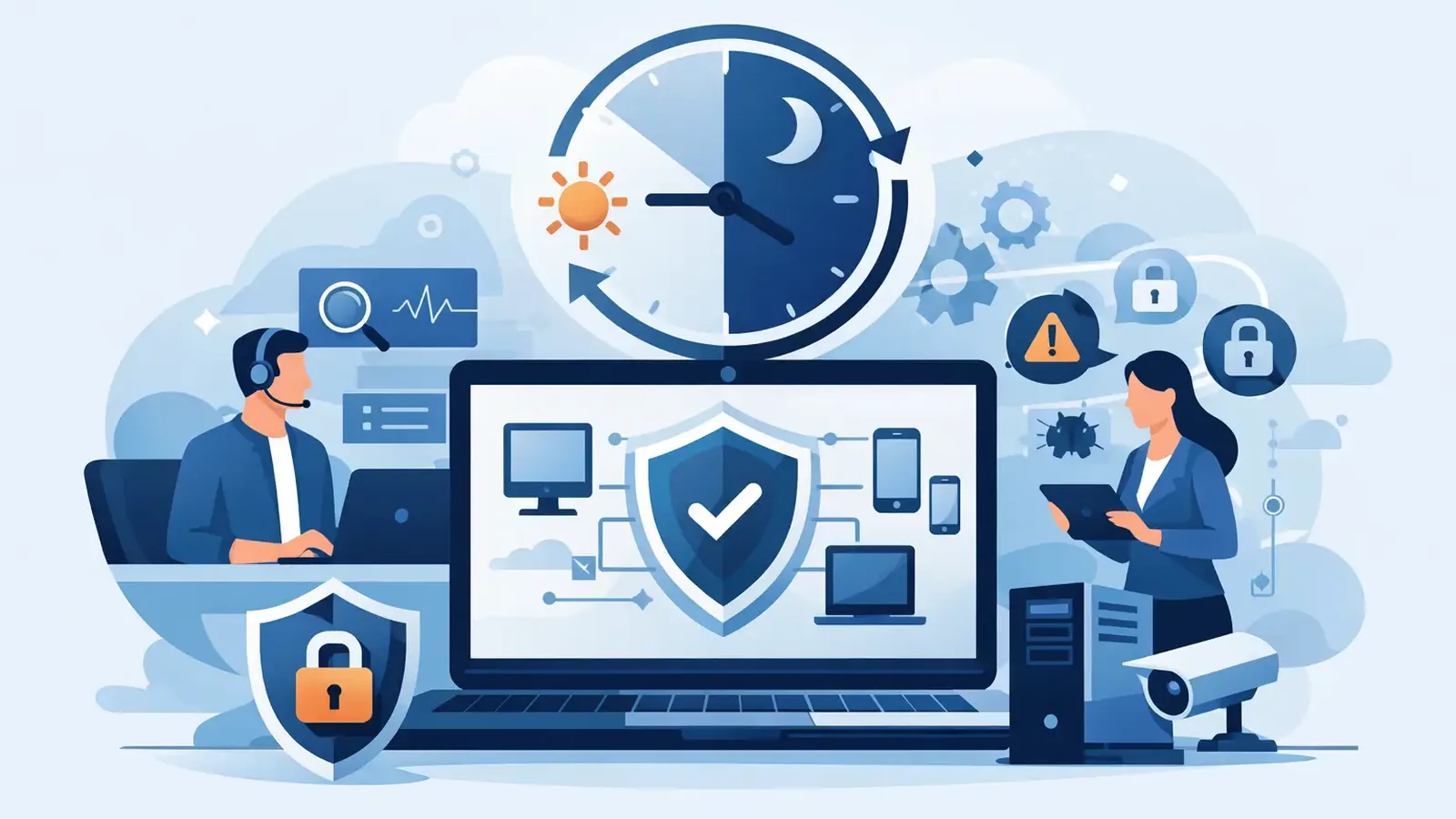
A suspicious login at 2:13 a.m. is not a problem that can wait for the office to open. Neither is a malicious file launched on an employee laptop, a ransomware tool probing a shared drive, or an attacker using a stolen password to move through your systems. A 24/7 endpoint monitoring service exists for that gap between a security alert and meaningful action.
Most small businesses already have antivirus software. Many have an IT provider, too. The harder question is: when a security tool identifies something unusual, who is actually watching, deciding whether it is dangerous, and taking steps to stop it?
Detection alone does not protect a business. A managed service turns detection into an operating responsibility. Someone investigates. Someone contains the device or activity when needed. Someone follows through on remediation and keeps you informed.
Antivirus Can Alert You, But It Cannot Own the Response
Traditional antivirus was built to spot known bad files. It still has a role, but modern attacks do not always arrive as an obvious virus. Attackers may use legitimate administrative tools, stolen credentials, deceptive email attachments, or scripts that look harmless until they begin making damaging changes.
Endpoint Detection and Response, often called EDR, provides deeper visibility into activity on computers. It can identify behaviors that deserve attention, such as unusual command activity, suspicious persistence mechanisms, credential theft attempts, or software trying to disable defenses.
But EDR also produces alerts. Some are harmless. Some need a closer look. A few may signal the beginning of a serious incident. If every alert lands in an inbox that no one has time or expertise to review, the technology is only doing part of its job.
This is where managed monitoring changes the model. Instead of handing your team another dashboard, a security operations team reviews suspicious activity around the clock and determines what requires action. That distinction matters most for organizations without an internal security department or overnight IT staff.
What a 24/7 Endpoint Monitoring Service Actually Does
A legitimate managed monitoring service is more than software installed on a computer. It combines endpoint security technology with people and defined response processes.
When suspicious behavior appears, the team assesses the evidence. They consider what happened, which device is involved, whether the activity matches known attacker techniques, and whether related systems may be at risk. This investigation helps separate a false alarm from a threat that needs immediate containment.
For confirmed threats, response may include isolating an endpoint from the network, stopping malicious processes, removing persistence mechanisms, and helping ensure the attacker cannot simply return through the same route. The right action depends on the incident. Isolating a device can protect the rest of the business, but it can also interrupt the employee using it. A professional response team weighs urgency against operational impact and communicates clearly about what is happening.
After containment, remediation and follow-through matter. Removing one file is not enough if an attacker created a new account, stole credentials, modified settings, or left another method of access behind. The response should address the full scope of the incident, document what was found, and identify next steps for the business and its IT provider.
That is the value of continuous monitoring: not merely knowing that something happened, but having trained people accountable for moving the situation toward resolution.
A Realistic Timeline of Managed Response
Imagine an employee opens a convincing attachment late in the day. The file launches a script that begins contacting an unfamiliar external service and attempts to collect browser-stored credentials.
The endpoint tool observes behavior that does not fit normal activity and generates a detection. A monitoring team reviews the event, examines the process chain and surrounding evidence, and confirms that the behavior is malicious. They isolate the computer before it can communicate further with internal resources or spread to shared locations.
The incident is then investigated for signs of persistence, credential exposure, or related activity on other devices. The affected endpoint is remediated, and the business is notified with practical guidance. If an outside IT provider manages the environment, that provider can handle related work such as password resets, account reviews, or restoration while the security team supplies the incident details and endpoint response.
The exact sequence varies. Not every alert is an emergency, and not every incident requires taking a device offline. What should not vary is that someone is evaluating the threat and taking responsibility for the response.
Why Small Businesses Need Human Monitoring
Small businesses are often targeted because attackers assume security coverage is thin. They may not have a security operations center, an after-hours help desk, or an employee whose job is to interpret endpoint alerts. Even a capable office manager or technology lead cannot reasonably monitor security events all night while running the business during the day.
A 24/7 service gives smaller organizations access to a function that would be expensive to build internally. It also reduces alert fatigue. Rather than asking your team to decide whether every notification is serious, the monitoring team filters, investigates, and escalates meaningful incidents.
This approach is especially useful for businesses that already work with an IT provider. Endpoint monitoring does not need to replace help desk support, Microsoft 365 administration, networking, line-of-business applications, or backup management. It can serve as a specialized cybersecurity layer that complements the existing technology relationship.
For example, a managed security team may investigate and contain endpoint activity, while your IT provider coordinates user access changes, server work, or business continuity tasks. Clear roles prevent security events from becoming a confusing series of forwarded alerts and unanswered questions.
Monitoring Is Stronger When It Includes Patch Management
Attackers frequently exploit vulnerabilities that already have available fixes. Endpoint monitoring can detect suspicious behavior after an attack begins, but patching reduces the number of openings an attacker can use in the first place.
Managed patch management helps keep supported operating systems and common applications current. It is not a replacement for monitoring, backups, multifactor authentication, or employee awareness training. Each control addresses a different part of the risk. Together, they create a more defensible environment.
There are trade-offs. Patches should be deployed thoughtfully because some business applications have compatibility requirements. A good patching process accounts for maintenance windows, device availability, restart needs, and exceptions that require review. The goal is not to apply changes carelessly. It is to avoid leaving known vulnerabilities open indefinitely because no one owns the process.
For cyber insurance applications and renewals, this combination is also easier to explain and document. Insurers increasingly ask whether a business uses EDR, monitors security events, applies patches, enforces multifactor authentication, maintains backups, trains employees, and has an incident response process. Having controls is useful. Being able to show that they are managed is better.
Questions to Ask Before Choosing a Provider
Not every service described as “managed” provides the same level of care. Some providers install software and leave alert review to the customer. Others send notifications but do not investigate or act. Before selecting a provider, ask direct questions about what happens after a detection.
Ask whether monitoring is truly available 24/7, whether trained security professionals investigate suspicious activity, and whether the provider can contain a confirmed threat. Ask what remediation includes, how incidents are communicated, and how the provider coordinates with your current IT team. You should also understand what reporting you receive and whether pricing is predictable on a per-device basis.
The answers should be plain and specific. “We provide advanced protection” is not a response plan. You need to know who watches the alerts, who makes the call when activity is malicious, and who stays involved until the immediate threat has been addressed.
PC Vax provides that focused layer of accountability with Huntress-powered managed EDR, continuous monitoring, threat investigation, containment, remediation, customer communication, and reporting. The service is designed for businesses that want professional endpoint security without handing over their entire technology environment.
Security Should Not Depend on Who Happens to Be Awake
A security alert at midnight should not become a Monday morning discovery. The right 24/7 endpoint monitoring service gives your business more than another security product: it gives you an experienced team with a defined job when suspicious activity appears.
That does not eliminate every risk. No provider can promise that every attack will be prevented. It does mean a potential incident is less likely to sit unnoticed while an attacker gains time, access, and options. For a business that depends on its computers to serve customers, protect data, and keep work moving, that is a practical form of peace of mind.
PC Vax provides cybersecurity services, not insurance advice. Cyber insurance requirements vary by carrier, policy, and applicant, and PC Vax does not guarantee insurance eligibility, approval, coverage, or premiums.
Professional Cybersecurity. Made Simple.